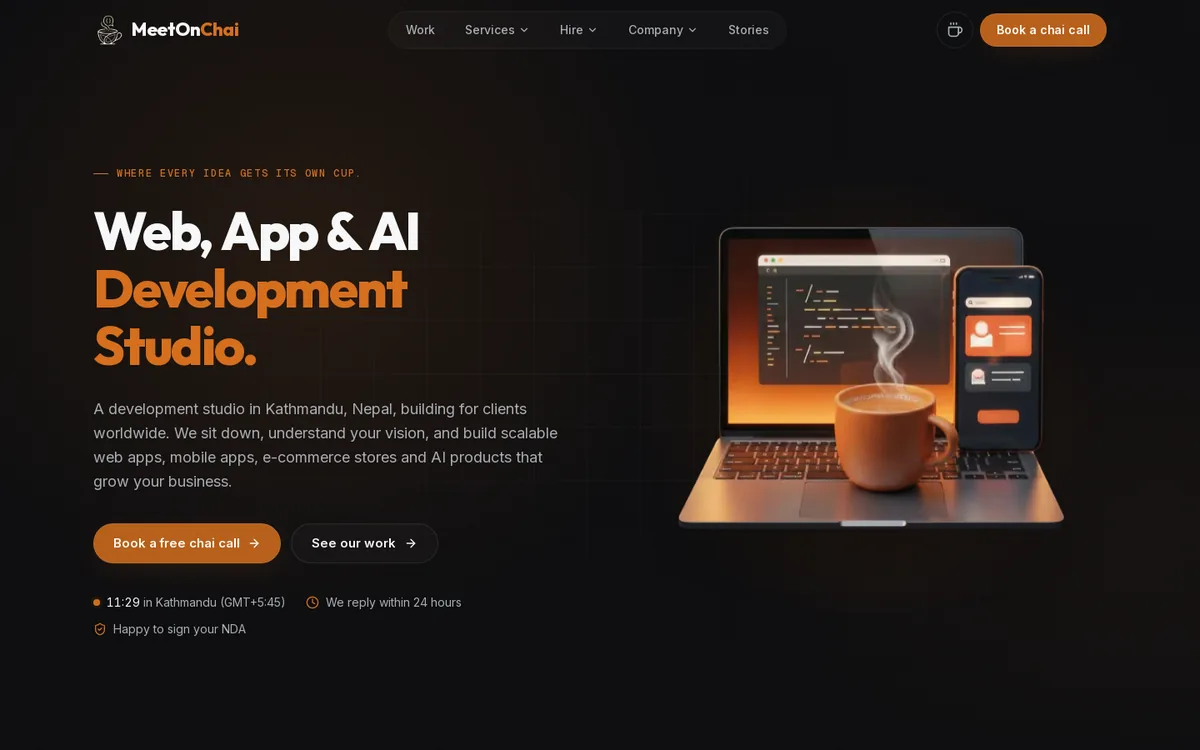
Most small businesses in Nepal do not need a big "AI strategy." They need one slow, boring job to stop eating their week. Answering the same customer questions on WhatsApp. Typing orders into a sheet. Searching old PDFs for one price. These are the jobs where an AI automation company in Nepal can help the most.
I am Hompushparaj Mehta, and I am a co-founder of MeetOnChai Studio, a small team in Kathmandu. In this guide I will explain, in plain words, what AI automation really is, what a studio like ours builds, how a project runs, how long it takes, and when you should not hire us.
You do not need to know any tech to read this. If you can run a shop, a school, a clinic or a startup, you can follow along. By the end you will know what to ask, what to avoid, and what a sensible first AI project looks like.
What does an AI automation company in Nepal actually do?
An AI automation company takes a repeated task and teaches software to do it. The software can read text, listen to speech, look at images, or search through your files. Then it acts on what it found.
Think of a good office assistant who never gets tired. You give clear rules. You show examples. After that, the assistant handles the easy 80 percent and calls you for the hard 20 percent.
Here is a simple picture of the difference between old software and AI software.
| Old software | AI software |
|---|---|
| Follows fixed rules you type in | Learns patterns from examples and text |
| Breaks when the input looks new | Can handle messy, new input |
| Needs exact words to work | Understands normal human language |
| Same answer every time | Can write a fresh answer each time |
This is why AI is useful for customer chat, document reading and phone calls. People do not speak in neat forms.
Is AI automation only for big companies?
No. In fact, small teams often gain more. A bank has hundreds of staff to share the boring work. A five-person business does not. When one person saves ten hours a week, that is a big change.
The cost is also lower than many people think. A focused AI feature added to a product you already have is far cheaper than a giant "AI platform." We will come back to this when we talk about pricing.
What is the difference between AI automation and AI development?
The two words overlap. Here is a simple way to think about them.
- AI automation means using AI to do an existing job faster. Example: a chatbot that answers customer questions.
- AI development means building something new with AI inside. Example: a new app that reads medical reports and flags problems.
Most real projects mix both. You start with one job to automate. Then you notice you need a small app, a login, a dashboard and a payment page around it. That is why we build both sides.
Who is MeetOnChai Studio?
MeetOnChai Studio is a web, app and AI development studio based in Kathmandu, Nepal. We build for clients in Nepal, India and other countries. Our home page says it simply: where every idea gets its own cup.
We are a small team, and we like it that way. The two co-founders, Satish and me, are the people you speak to. There is no layer of account managers between you and the person who writes the code.
You can read more about the studio at MeetOnChai Studio, including our services and past work.
What does "founder-led" mean in real life?
It means three things.
- The person on your first call is the person who will help build the product.
- When you send a message, a founder reads it. We reply within 24 hours.
- If something goes wrong, there is no "ticket queue." You message us.
This matters a lot for AI work. AI projects often fail because the builder and the business owner do not understand each other. A short chain of communication fixes that problem before it starts.
Where are we, and can we work with clients far away?
We are in Kathmandu, which is GMT+5:45. India is 15 minutes behind us. The Gulf is about 1 hour 45 minutes behind. Europe is roughly 4 hours behind, and the US East Coast is about 10 hours behind. We plan meetings around these gaps, and we are happy to sign your NDA before you share any detail.
What numbers can I trust?
- 50+projects delivered
- 12+happy clients
- 98%client satisfaction
- 5/5average client rating
Our own records show 50+ projects delivered, 12+ happy clients, a 98 percent client satisfaction score and a 5 out of 5 average rating. These numbers come from our own records and our own site. We have not had them checked by an outside group, so please treat them as our claim and not as a ranking. The best proof is to talk to our clients. We list them with their real websites below.
Which AI services does MeetOnChai Studio offer?
Our AI work sits in a few clear groups. I will explain each in one plain paragraph, so you can see which one fits your problem.
AI chatbots and conversational AI
A chatbot answers questions in normal language. A good one does more than say hello. It knows your products, your prices, your opening hours and your policies. It can pass a hard question to a real person.
Most Nepali businesses talk to customers on WhatsApp, Facebook or a website. A chatbot can sit in one of these places and handle the repeated questions. "Do you deliver to Lalitpur?" "What is the price of this?" "Where is my order?"
We add chatbots and custom AI features to products you already have. You do not need to rebuild your website.
LLM integration and RAG
An LLM (large language model) is the type of AI behind tools like ChatGPT. It writes and understands text very well. Our site lists work with providers such as OpenAI and Anthropic, and with tools like LangChain.
The problem is that an LLM does not know your business. It may guess, and a guess can be wrong. This is where RAG helps. RAG stands for retrieval-augmented generation. It is a method where the system first looks up the right pages in your own documents, and only then writes an answer from them. You can read a clear overview on Wikipedia's RAG page.
Here is a simple example. A college has a 90-page rules booklet. A student asks, "What is the late fee for exam forms?" A RAG system finds the right page, reads it, and answers in one clean sentence, with the source. No one has to dig through the PDF.
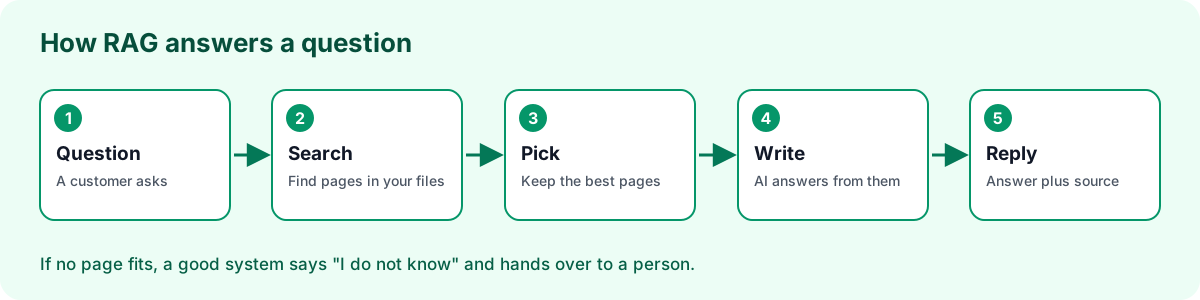
Good RAG work is mostly about the boring parts. How do you cut the documents into pieces? How do you keep them fresh? How do you stop the system from answering when it does not know? We spend most of our time on those questions.
Voice AI agents
A voice AI agent talks on the phone or through a microphone. It listens, understands, thinks, and speaks back. Under the hood, three steps run in a loop: speech-to-text, a language model, and text-to-speech.
Where could this help in Nepal? Think of a clinic that takes appointment calls, a restaurant that takes phone orders, or a shop that answers "are you open today?" all day long. A voice agent can handle the simple calls and pass the rest to a human.
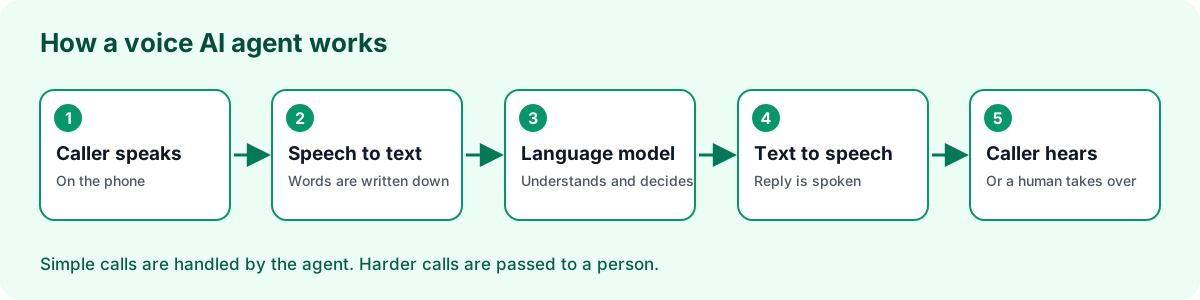
Voice is harder than chat. People interrupt, there is background noise, and a slow reply feels rude. We keep the first version small and test it with real calls before we grow it.
Machine learning and deep learning
Machine learning (ML) finds patterns in numbers and past records. It can guess next month's sales, spot a customer who may leave, or suggest products a buyer might like. Deep learning is a stronger type of ML. It is the tool for images, sound and complex patterns, such as checking photos for damage or reading handwriting.
Not every problem needs ML. Many problems are solved better by a simple rule. We will tell you if that is the case. We would rather save you money than sell you a model you do not need.
MLOps: keeping AI working after launch
MLOps means looking after a model after it is built. A model that works on launch day can slowly get worse as the real world changes. MLOps is the work of packaging the model, putting it online, watching how it performs, and retraining it when needed. There is a helpful summary on Wikipedia's MLOps page.
Think of a car. Building the car is one job. Servicing it every few months is another. Many teams only do the first job. We include the second.
Why does the full-stack work around AI matter?
An AI feature never lives alone. A chatbot needs a website. A document reader needs a login and a place to upload files. A prediction needs a dashboard so a person can see it.
That is why we also build the parts around AI. Our site lists these services:
- Web app development (Next.js apps and SaaS products)
- E-commerce development, with local payments and WhatsApp ordering
- Mobile app development for iOS and Android
- SaaS development, with accounts, roles and subscription billing
- UI and UX design
- MVP and product development
- Payment gateway and API integration
- DevOps, website redesign, maintenance and support
If you have used four vendors for one product, you know the pain. Each one blames the other when something breaks. One team that owns the whole thing removes that problem.
What about eSewa, Khalti and local payments?
If you sell in Nepal, payments matter. Our site lists integrations with eSewa, Khalti, UPI, Razorpay and Stripe, with webhooks done properly. A webhook is a small message that a payment provider sends your system to say "this payment worked." If you handle it badly, you get orders that are paid but not marked paid.
The Giftkdiu store we built takes payments through eSewa and Khalti. Khalti's own site describes the service as a unified payment platform, and you can see it at khalti.com.
What does real work look like?
AI is a hot topic, so I want to be careful and honest here. The client projects shown on our site are mostly web and e-commerce builds. They show how we work: fast, clear and tied to real business goals. They are not all AI projects, and I do not want to pretend they are.
Here are five of them, with live websites you can open yourself.
| Project | Place | What we built | Stack |
|---|---|---|---|
| MangoMasti | India | Seasonal mango delivery store with a combo builder and WhatsApp checkout | Next.js, TypeScript, Vercel |
| Giftkdiu | Nepal | Gifting and same-day delivery store with eSewa and Khalti | WordPress, WooCommerce |
| Oryizon | India | Full store for organic Moringa powder with UPI, cards and order tracking | Next.js, TypeScript |
| Shwetrex Pharma | India | Company website with product catalogue and distributor enquiry flow | Next.js, TypeScript |
| WS Nepal | Nepal | B2B marketplace for verified Nepali suppliers | React, TypeScript |


What can we learn from MangoMasti?
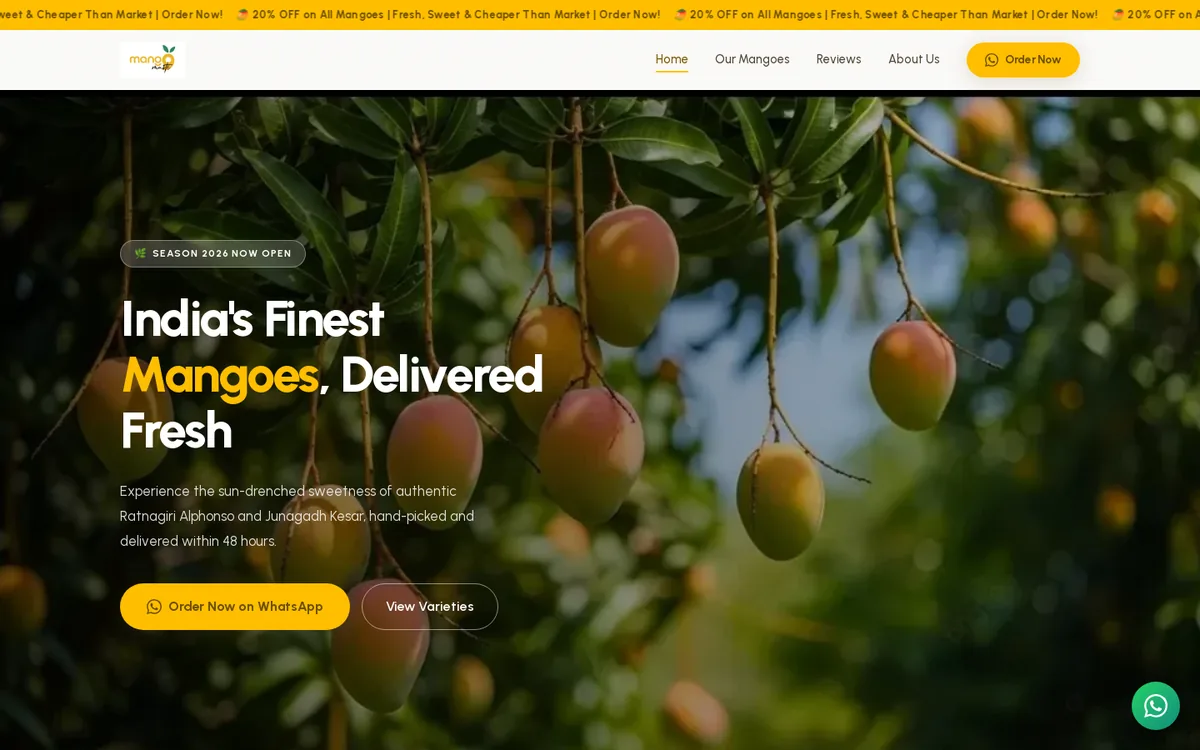
MangoMasti sells mangoes, and mangoes have a short season. The site had to be live before the harvest began in late February. So we cut the first version down. User accounts, a payment gateway and reviews were left out on purpose. Orders came through WhatsApp, which is how the customers already liked to buy.
The lesson applies to AI projects too. Start with the smallest version that does real work. Add the rest later.
What can we learn from Giftkdiu?
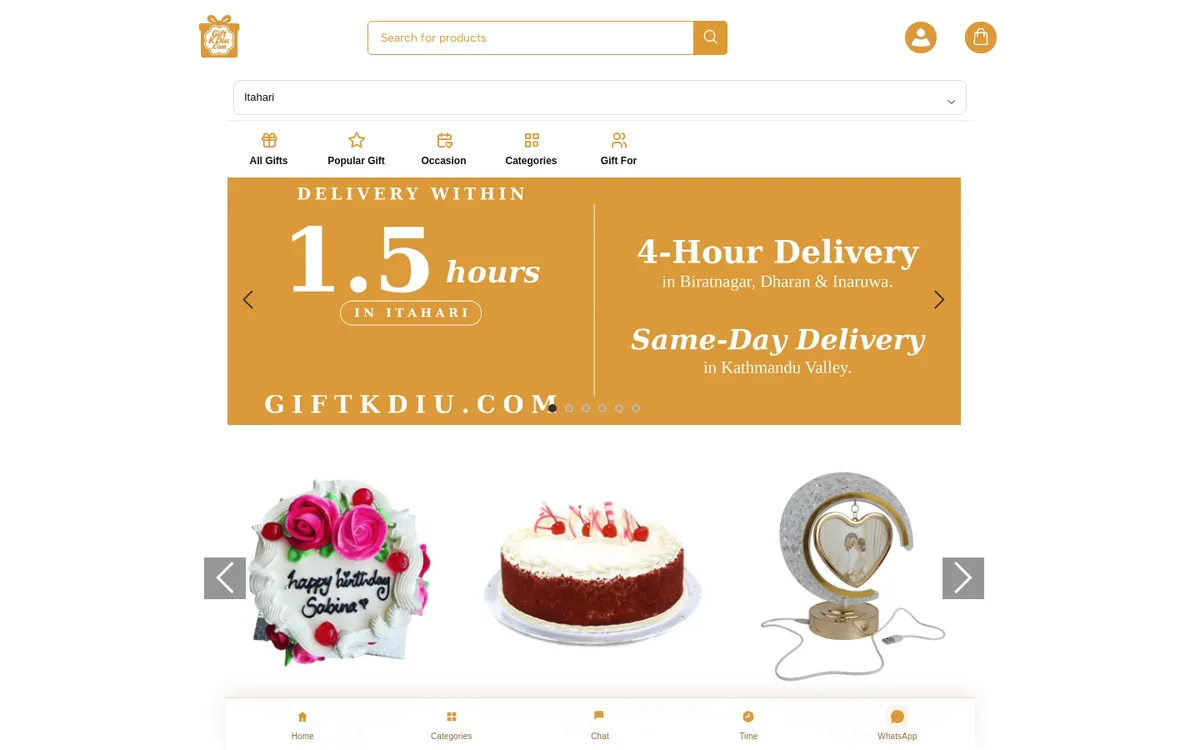
Giftkdiu had a small budget and a tight timeline. We chose a proven commerce stack over a custom build. That choice saved money and time. A good studio does not always build the fancy thing. It builds the right thing.
The founder of MangoMasti, Bhavya Santhoshi, said the team "took the time to understand what we had in mind." We list more client names, such as Bikesh Upadhyay of Oryizon and Shib Narayan Pandit of Giftkdiu, on our site.
How does an AI project run, step by step?
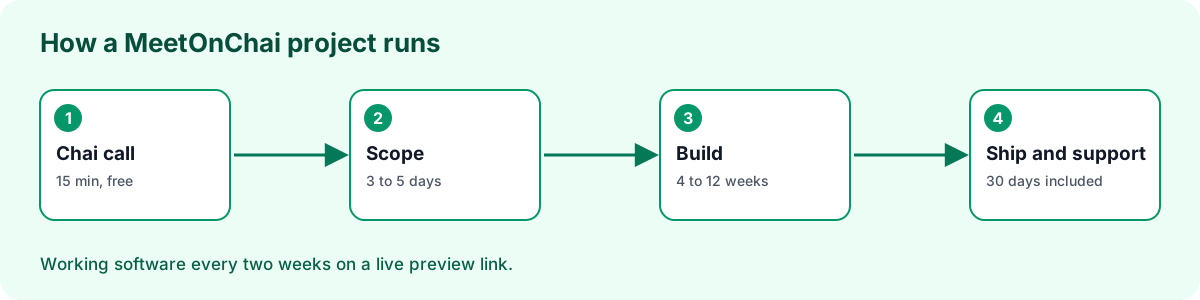
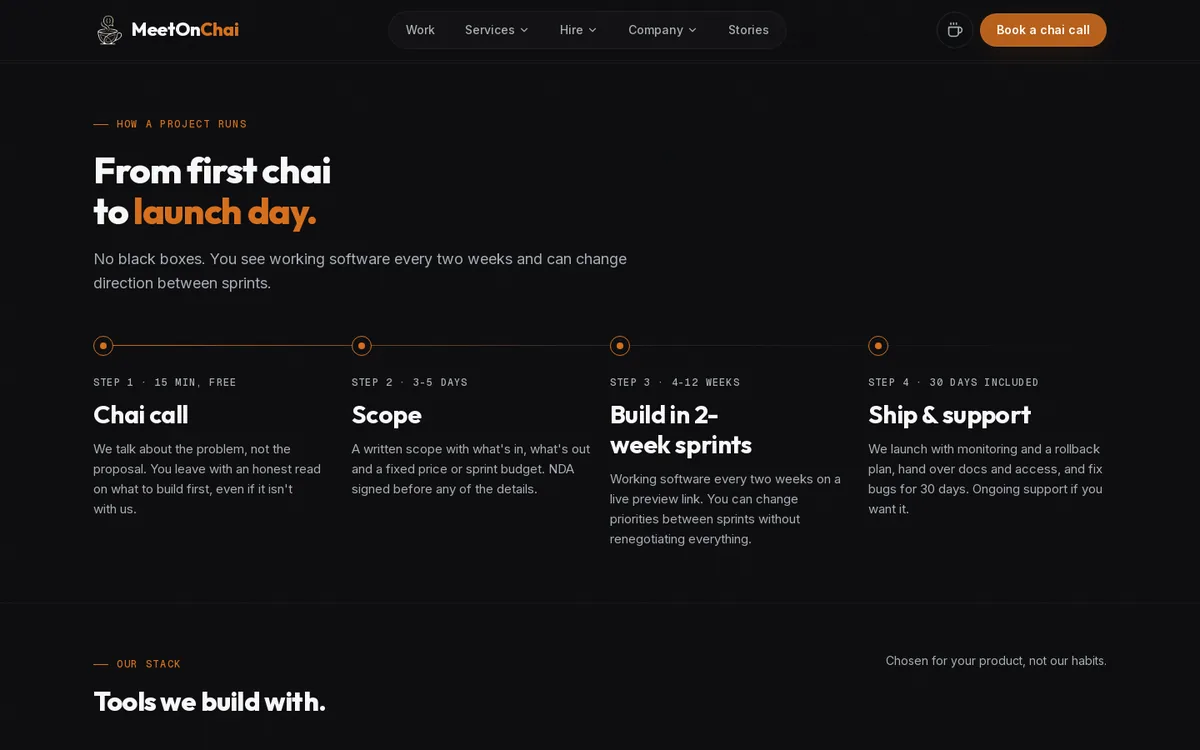
Our site calls this "from first chai to launch day." There are four steps. I will add what each means for an AI project.
- Chai call (15 minutes, free). We talk about the problem, not a proposal. For AI, the key question is: what job is eating your time, and how will we know it is solved?
- Scope (3 to 5 days). You get a written scope that says what is in, what is out, and the price or sprint budget. We sign an NDA before any detail if you want one.
- Build (4 to 12 weeks, in 2-week sprints). You see working software every two weeks on a live preview link. You can change direction between sprints.
- Ship and support (30 days included). We launch with monitoring and a rollback plan. We hand over docs and access. Then we fix bugs for 30 days.
What do you need to bring to the first call?
Not much. Bring these four things, and the call will be useful.
- One sentence about the problem. "Our team answers 100 WhatsApp questions a day, and most are the same."
- Three to five real examples. A real customer message is better than a description.
- Any documents or data you have. Price lists, FAQs, old orders, call notes.
- A rough idea of what "success" looks like. "Cut reply time from two hours to two minutes."
Why do we start small?
Because AI is hard to predict on paper. You often only learn what works by trying it on real data. So we build a thin first version, test it on real examples, and then improve it. This is cheaper than a big plan that turns out wrong.
How long does it take, and how is it priced?
Our pricing page shows typical timelines. For AI integration, expect about 2 to 4 weeks. An MVP or an e-commerce store usually takes 4 to 8 weeks. A full product can take 2 to 4 months.
We do not publish a price list. We give a written quote after one conversation. I know that is annoying if you just want a number. But AI projects vary a lot. A chatbot for ten FAQs and a voice agent that books appointments are very different jobs. A fake "starting at" price would mislead you. You can read how we work on our pricing and engagement page.
There are three ways to work with us.
| Model | How it works | Good for |
|---|---|---|
| Fixed-scope project | A fixed price, paid per milestone | A clear, well-defined job |
| Dedicated developer or team | A monthly engagement | Long, growing products |
| Time and materials | Sprint budgets with weekly time reports | Jobs where the scope may change |
What is always included?
Whatever model you pick, these come with it: a free first call, a written scope before money moves, an NDA on request, a live preview link every sprint, code in your own repository, a launch with monitoring, handover docs and credentials, and 30 days of bug fixes.
The point about code ownership matters. The code is yours. If you ever want to leave us, you can take it with you.
What does AI cost to run after launch?
This is a question many people forget. Many AI features call a paid service every time they work. If your chatbot gets busy, the bill goes up. We help you estimate this before you commit, and we pick the lightest model that does the job well. A smaller model is often faster and cheaper, and it is good enough for simple questions.
Why do we build this way? (The story)
I want to share how we think, because it explains the choices above.
Our studio's rules are short. We talk until the problem is boring. We define scope until it is uncomfortable. We build fast and review slowly. We ship, document and stay accountable.
I like the first rule the most. Many projects go wrong because the first conversation was too short. Everyone nodded, nobody wrote anything down, and three months later the product was not what the client had in mind. So we ask many questions at the start. Some clients find this slow. Most are glad later.
The second reason is that I work on both sides: I build AI features, and I build the plain products around them. I have seen a clever model fail because the form around it was confusing. I have also seen a simple script win because it saved a team two hours a day. That mix taught me to respect boring solutions.
I am still learning. AI tools change every few months, and I do not want to pretend I know everything. What I can promise is that we test things on your real data before we say they work, and that we tell you plainly when something will not.
What have I learned about AI projects?
Three lessons stand out.
- The data matters more than the model. Messy documents give messy answers. Cleaning your files is often the best first step.
- A human fallback is not a failure. The best systems know when to hand over to a person.
- Small wins build trust. A chatbot that handles 10 questions well is better than one that handles 100 badly.
What AI jobs could you automate first?
If you are not sure where to start, use this checklist. Look for jobs that are repeated, rule-based, and cost real hours.
- Answering the same customer questions on WhatsApp, Instagram or your website
- Booking appointments or taking simple phone orders
- Reading invoices, forms or IDs and typing the data into a system
- Searching long documents for one answer (policies, contracts, manuals)
- Sorting support emails and sending them to the right person
- Writing first drafts of product descriptions or replies, which a person then checks
- Spotting which customers are likely to stop buying
- Flagging unusual orders or payments for a human to check
How do you pick the first one?
Score each idea from 1 to 5 on three things: how much time it costs, how clear the rules are, and how safe it is if the AI gets one wrong. Start with a high score on time, a high score on clear rules, and a high score on safety. A chatbot answering opening-hours questions scores well. An AI approving loans on its own does not.
What should stay with a human?
Anything where one mistake is costly or sensitive. Medical advice, legal advice, large payments, and hiring or firing decisions should have a person in charge. AI can prepare the work. A human should sign off.
What mistakes should you avoid with AI automation?
I have seen the same mistakes again and again. If you avoid these five, you are ahead of most people.
Starting with the tool, not the problem
"We need AI" is not a goal. "We want to cut reply time to two minutes" is a goal. When the goal is clear, picking the tool is easy. When it is not, you pay for a demo that nobody uses.
Skipping the test on real examples
A demo with three neat questions always looks great. Real customers write in short, messy, mixed-language messages. Test with at least 50 real examples before you launch. Include the ugly ones, such as Roman Nepali, typos and half sentences.
Trusting the AI without a safety net
An AI can sound sure and still be wrong. Give it a way to say "I do not know" and pass the chat to a person. Log the answers, and review a sample every week at the start. This is a small habit with a large payoff.
Forgetting about privacy
Customer names, phone numbers, bills and medical details are sensitive. Ask where your data goes and who can see it. Ask whether it is used to train anyone's model. A good partner will answer clearly, and will sign an NDA if you ask.
Expecting it to be finished at launch
AI work is never "done." Your prices change, your products change, and customers find new ways to ask things. Plan a little time each month to look at the results and fix gaps. This is also why we include 30 days of bug fixes, and why we offer monthly support if you want it.
What does a healthy first month look like?
Here is a simple picture of a good start.
- Week 1: one call, one written scope, and a pile of real examples.
- Weeks 2 and 3: a first working version on a preview link. You test it and send feedback.
- Week 4: fixes, a small launch to a few real users, and a plan for what to measure.
After that, you look at the numbers. How many questions did it answer on its own? How many did it pass to a person? Did customers seem happier? The numbers tell you what to build next.
Who is MeetOnChai Studio for, and who is it not for?
Honesty helps both sides, so here is my plain view.
It is a good fit if you are
- A startup that needs a first product, with an AI feature at the core, in weeks and not months
- A small or mid-size business in Nepal or India that wants to automate one painful job
- An e-commerce brand that needs local payments such as eSewa, Khalti or UPI
- A founder who wants to talk to the people building the product
- A company outside Nepal that wants a careful, friendly team in a different time zone
It may not be a good fit if you need
- A team of hundreds of engineers for a huge enterprise rollout
- A ready-made software product you can buy off the shelf today (tools like that exist, and they may suit you better)
- The cheapest possible price with no written scope
- An AI to make high-risk decisions with no human check
- A 24/7 operations center for a very large system
If you are not sure, book the free call. If we are not the right team, I will say so and, when I can, point you somewhere better.
How do you choose any AI partner?
Even if you never hire us, use this checklist. It works for any company.
- Ask for live examples. Can you open and use their past work?
- Ask who will do the work. Is the person you meet the person who builds?
- Ask what is out of scope. A good partner will tell you what they will not do.
- Ask who owns the code. The answer should be you.
- Ask what happens after launch. Is there support, and for how long?
- Ask how they test AI. A good answer mentions real examples and a human check.
- Be careful of big promises. Any "100 percent accurate" claim is a warning sign.
How do studios, freelancers and big vendors compare?
| Solo freelancer | Small founder-led studio | Large vendor | |
|---|---|---|---|
| Speed of reply | Fast, but may be busy | Fast, direct to founders | Slower, goes through layers |
| Skills range | Narrow | Wide (design, code, AI, payments) | Very wide |
| Risk if one person leaves | High | Medium | Low |
| Price | Lowest | Middle | Highest |
| Best for | Small, single tasks | Products and AI features | Huge programs |
No row here is "best" for everyone. Pick the column that matches your size and risk.
Frequently asked questions
What does an AI automation company in Nepal do?
It builds software that does repeated work for you using AI. Examples include chatbots that answer customers, tools that read documents, voice agents that take calls, and models that predict sales. A good company also builds the app, login and payments around the AI so the whole thing works in real life.
How much does AI automation cost in Nepal?
It depends on the job. A small chatbot costs far less than a voice agent or a custom model. MeetOnChai Studio gives a written quote after a free 15-minute call, either as a fixed price per milestone or as sprint budgets. You can see the models on the MeetOnChai Studio pricing page.
How long does it take to add AI to my business?
A focused AI integration usually takes 2 to 4 weeks at our studio. A first product (MVP) takes 4 to 8 weeks. A full product can take 2 to 4 months. The speed depends on how clear the job is and how ready your data is.
Can a small business really use AI?
Yes. Small teams often gain the most because one saved hour is a large share of their week. Start with one repeated job, such as answering common questions, and measure the result before you grow. Pick a job that happens every day and has clear rules, and keep a person in charge of the final check.
What is RAG, and why does it matter?
RAG lets an AI look up answers in your own documents before it replies. This cuts down guessing. It is useful for support bots, policy search and internal help tools, because answers can point back to a real source. It also keeps answers fresh, since you only change the document and not the AI itself.
Do you build voice AI agents?
Yes. A voice agent listens, understands, and speaks back. It can handle simple calls such as appointment booking or order taking and pass harder ones to a person. We test with real call samples first, because noise and accents are the hard part.
What is MLOps?
MLOps is the work of putting a machine learning model online, watching it, and retraining it when it gets worse. Without it, a model that worked at launch can slowly drift. We treat it as part of the project, not an extra.
Can you integrate eSewa and Khalti?
Yes. We have built stores that take eSewa and Khalti, and our site lists UPI, Razorpay and Stripe too. We set up webhooks properly, so paid orders are marked paid. Tell us which gateway your customers use, and we will plan the setup in the written scope.
Will I own the code?
Yes. Your code lives in your own repository, so you can take it with you if you ever want to work with another team. We also hand over documents and credentials at launch, and we fix bugs for 30 days after the launch at no extra cost.
Can you sign an NDA?
Yes. We are happy to sign your NDA before any detailed talk, so you can share your idea without worry. The written scope comes after the NDA, and the first 15-minute chai call is free. You can book it through the contact page on our website.
Final thoughts: choosing an AI automation company in Nepal
AI does not have to be big, scary or expensive. The best first project is small: one repeated job, a clear goal, and a real test on your own data.
If you want a partner for that, an AI automation company in Nepal that is small, direct and honest may suit you well. We are one option. Use the checklist in this guide to compare us with anyone else, and trust your own judgment.
If you would like to talk, book the free 15-minute chai call. Bring one problem and a few real examples. You can start at meetonchai.com.
The same team also built an AI-powered point of sale for shops and restaurants. If that interests you, read why I built Chautari.